Market House Plaza
I knew nothing about the proposal until I saw a note about the Community Conversation held 21 May. I could not stay for the entire program but I did stay long enough to learn what the proposal entailed.
Before leaving that 21 May meeting, I had the chance to ask one question which I thought to both be obvious and that no one might ask in this early stage: Will the shade sails shown in the renderings of the final concept be installed during the trial?
Without shade from the summer sun over a good portion of the space reclaimed from vehicles, the trial does not stand a fair chance — the heat on that bit of macadam will be brutal. A handful of market umbrellas is not enough.
That said, the sides of the old market hall can be a delightfully shady and the width of the space claimed for pedestrian use is generous.
I thought this would be the end of my thinking and I would be an obvious supporter. But I decided later that I could go either way. Shepherdstown is loved now for its pedestrian environment. Why would it need this?
Try it, you’ll like it!
We have an expanded trial of this idea every Sunday during market season. Other trials come and go… parades, street fest, &c.
Predictably, voices of opposition to the idea have been strong on social media. The concerns sound legitimate. Having been familiar with Shepherdstown for over 30 years now, they are sadly predictable.
Here is where my bias creeps in: I treat the portion of King Street in question as if it is closed to vehicles all the time, walking diagonally across it when no traffic is present. (For more about my bias, please visit https://rt230.wordpress.com, a project I started in 2010, where this will be re-posted.)
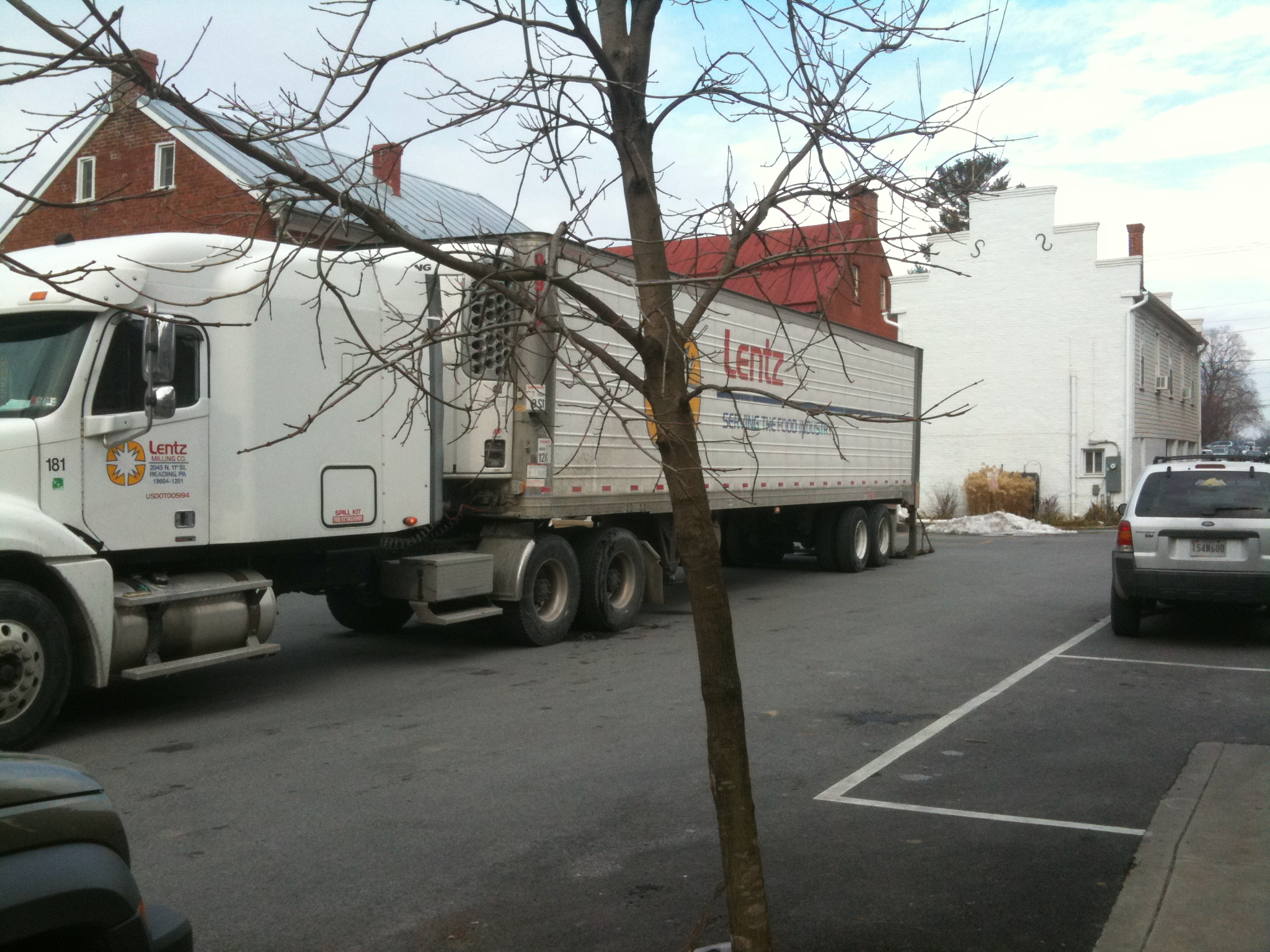
I am long aware of this space use as a loading zone, more amazed that we have tractor trailers delivering goods in town at all. I would like a primer on how tractor-trailers arrive there but the question is moot. They arrive. Safe to say, it is too easy for us to take for granted the idea that big rigs should be found on village streets.
Another common comment theme touches emergency access. I don’t know the physical limits of this. I do care about emergency access but more at our railroad crossings than for buildings on German Street, where emergency responses will happen on German Street, not Back Alley nor King Street.
Should life prove otherwise, we could employ modal filters. Honestly though? We are looking at the wrong part of the system: https://www.youtube.com/watch?v=j2dHFC31VtQ&t=81s
Atop all, and always fascinating to me, is the repetition of complaints levied about Shepherdstown — parking and traffic. I never detect irony in these comments, despite them coming from people who are contributing to the issue.
Shepherdstown is a strong community because of the river crossing and despite the river crossing. And traffic, as everyone knows, is growing worse with every subdivision. Closing this small piece of King Street is unlikely to exacerbate traffic issues or the parking “problem”. (Air quotes here because the solution is part of why people love the town. You can walk from a parking place that is no further than your stroll as a big box store.)
“No one goes there anymore. It’s too crowded.” — Yogi Berra
Alluded to above, the parking and traffic problem is baked into Shepherdstown. People want to visit a place where it is difficult to find parking. People want to be in a place that is walkable — dense with activity. No one goes to the big box parking lot for that.
Before the new library, I spent time sketching ideas for expanding the existing market house library location by expanding into the street, thereby closing a portion. The library and town had done the same. Why did I not worry about it then? Because Shepherdstown is not a dead-end subdivision. It thrives on a multi-node street grid.
As it happened, I later worked on the architect selection process and, importantly, interviewed focus groups for establishing the program for the new library.
From that effort, came a strong recommendation to use the old market hall as a library annex. Why is this important in this context? Because it speaks of the love for having a “third place” at the heart of town.
A plaza alone does not a third place make (I’m looking at you Boston City Hall), but it can facilitate one. I’ve seen third place activity on the sidewalk at the bakery. We should encourage that activity to grow.
A market building in the middle of a street engages the street. Our version does this by its scale, details, and a single beloved tree.
As many market buildings did in an age before cars, it is possible to imagine a future-old market building which joins that effort in earnest, where its ground floor is stitched with the space surrounding it, where we move through a ground floor filter. For this, the exterior place must come first.


